


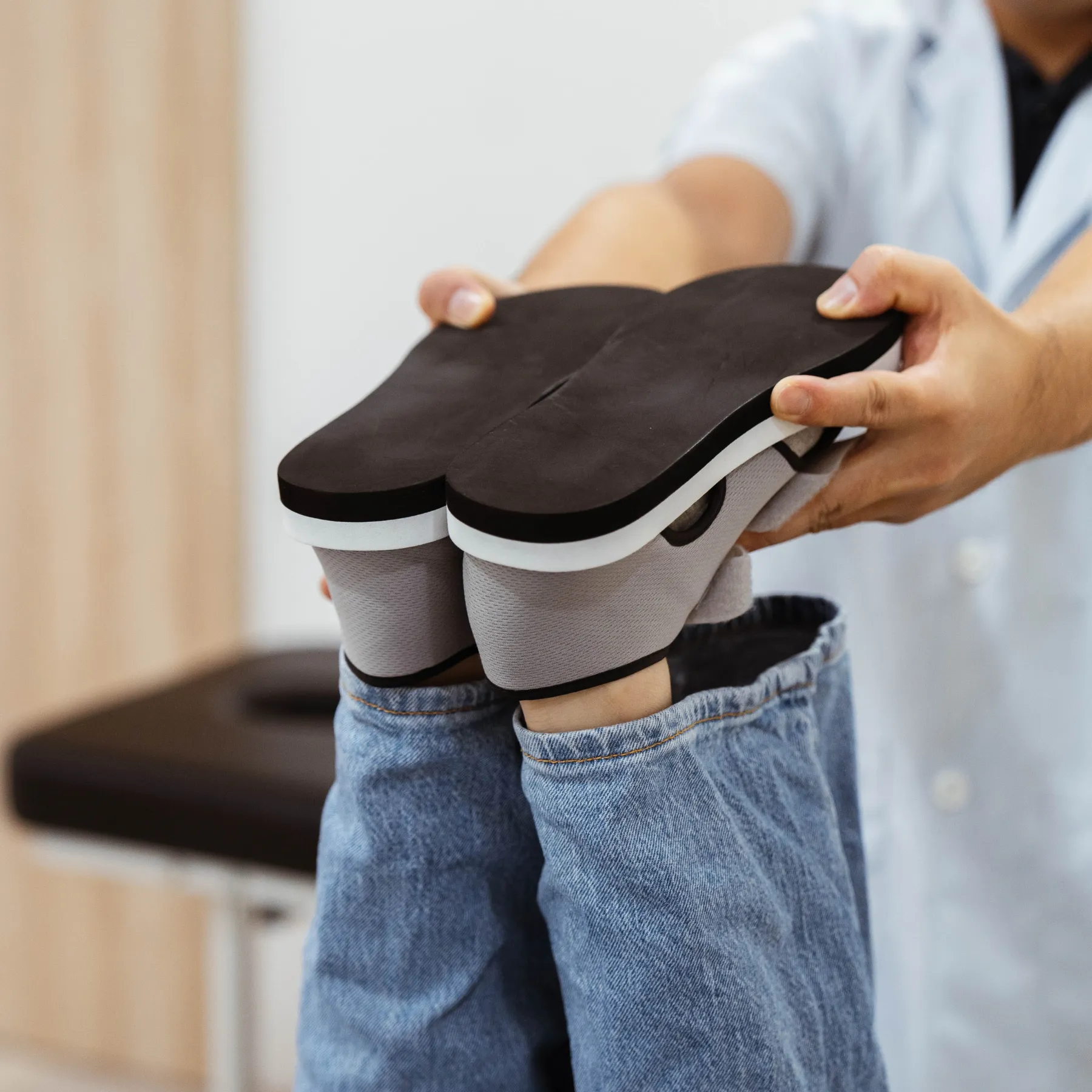
Unevenly worn soles and unstable gait are caused by leg length discrepancy (LLD) and pelvic tilt in over 70% of cases—not just bad shoes. Nature Concept T&CM Johor Bahru uses dynamic plantar pressure gait analysis, not the static 3D foot scans common at insole shops. We capture your center-of-pressure trajectory, bilateral plantar load distribution, and stance time asymmetry during actual walking to identify structural or functional LLD in minutes, then correct it with RSE Skeletal Balance Treatment.
- Asymmetric shoe wear is an early warning sign of LLD; a 5 mm difference can trigger whole-body compensation
- 3D scans only show what your foot looks like; Nature Concept's dynamic gait analysis shows why you walk unevenly
- LLD is either structural (true bone length difference) or functional (pelvic tilt, foot arch collapse, muscle imbalance)
- Dynamic gait data quantifies center-of-gravity shift %, bilateral stance time differential, and peak pressure asymmetry—the diagnostic gold standard
- RSE uses the US Activator instrument for non-invasive, painless, crack-free precision correction
- 4-Step System: Dynamic Gait Assessment → Myofascial Release → Precision Correction → Functional Stabilization

Root Cause Analysis: Why Are Your Shoes Wearing Unevenly?
The Mechanism of Leg Length Discrepancy & Whole-Body Compensation
Leg length discrepancy (LLD) refers to a measurable difference between the lower limbs. Clinically, a difference of 5 mm or more is considered significant. When the foot support surfaces are not level, the body initiates a compensation chain: pelvic tilt → scoliosis → uneven shoulders → head shift. Over time, this not only wears out shoes asymmetrically but also leads to knee osteoarthritis, lumbar disc compression, and chronic neck-shoulder pain .
From a TCM perspective, the Yizong Jinjian states: “When the spine is aligned, Qi and blood flow freely.” LLD-induced pelvic tilt obstructs the Du and Bladder meridians, creating a domino effect. Simply changing shoes or buying over-the-counter insoles without first diagnosing structural vs functional LLD often treats symptoms only and may worsen pelvic rotation.
Many insole shops in Johor Bahru claim to offer “3D foot scanning,” but there is a fundamental diagnostic gap between the two technologies:
| Dimension | Common "3D Foot Scan" at Insole Shops | Nature Concept "Dynamic Plantar Pressure Gait Analysis" |
|---|---|---|
|
Capture State |
Static standing, foot stationary |
Static standing + dynamic walking sequenc |
|
Data Type |
Foot 3D morphology (length, width, arch height) |
Plantar mechanical pressure + walking COP trajectory & stance time |
|
Diagnostic Logic |
“Your foot looks like this, so here’s an insole” — shape matching |
“Your COG shifts 12%, short side overloads 18%” — function matching |
|
Structural vs Functional? |
❌ Cannot differentiate; static shape may look identical |
✅ Distinguishes via stance time asymmetry & peak pressure imbalance |
|
Diagnostic Scope |
Foot only |
Pelvis, spine, lower-limb kinetic chain |
|
End Goal |
Sell insoles (product-driven) |
Diagnose LLD type + RSE skeletal correction (treatment-driven) |
Key Scientific Evidence: Research demonstrates that even a 3–6 mm LLD creates measurable dynamic gait asymmetries: stance time on the longer limb increases by 3.51%, mean pressure on the short side rises 1.23%, and peak pressure on the long side drops by 12.11%—this asymmetric plantar loading pattern only appears during walking . Static 3D scans completely miss this data .
3 Types of Leg Length Discrepancy (with Gait Data Signatures)
| Type | Cause | Gait Data Signature | Shoe Wear Pattern | Nature Concept Protocol |
|---|---|---|---|---|
|
Structural LLD |
Congenital growth, fracture malunion, post-joint replacement |
Short side shortened stance time, weaker push-off; COG fixed toward long side; pressure ratio often 60:40 |
Lateral wear on short side, medial wear on long side |
Precise measurement + RSE correction + custom compensation |
|
Functional Pelvic |
Pelvic rotation, SI joint misalignment, unilateral psoas spasm |
Unilateral heel inversion/eversion, abnormal COP trajectory, high bilateral asymmetry index; static vs dynamic data diverge |
Asymmetric wear, often with heel inversion/eversion |
RSE pelvic correction + core stabilization |
|
Foot Arch Collapse |
Unilateral flat foot / high arch, ankle misalignment |
Flat foot: excessive medial peak pressure; high arch: lateral pressure concentration; arch index changes >3–5 mm dynamically |
Medial wear (flat foot), lateral wear (high arch) |
Pressure scan + RSE ankle realignment + functional orthotics |
TCM Pattern Differentiation: Which Type Are You?
Qi Stagnation & Blood Stasis Pattern with LLD
Common after unilateral sprains or chronic poor posture. Micro-misalignment obstructs circulation. Gait analysis typically shows shortened single-leg stance (pain avoidance) and rapid COG shift to the opposite side. Patients feel unilateral hip/buttock stabbing pain and difficulty standing after sitting.
Liver-Kidney Deficiency Pattern with LLD
Frequent among middle-aged or postpartum individuals. TCM holds that “the kidney governs bones and the liver governs tendons.” Deficiency leads to poor joint stability and gradual arch collapse. Gait analysis reveals prolonged bilateral stance (poor balance) and irregular COG sway path. Patients often feel weak, sore legs and tight soles in the morning.
Wind-Cold-Damp Bi Pattern with LLD
Malaysia’s tropical climate plus air-conditioning allows pathogenic factors to invade joints. Dampness obstructs Qi flow. Gait analysis shows narrowed step width (fear of slipping) and irregular walking speed. Symptoms fluctuate with weather changes, accompanied by morning stiffness.
Nature Concept RSE Skeletal Balance Treatment: From Dynamic Gait Analysis to Precision Correction
RSE (Skeletal Balance Treatment) at Nature Concept T&CM follows a “dynamic assessment first, precision correction second” scientific protocol. Physician Liao’s team combines dynamic plantar pressure gait analysis with Activator instrument micro-adjustments to detect millimeter-level bony deviations and safely restore lower-limb biomechanics.
The 4-Step Therapeutic System (Gait-Data Driven)
Step 1: Dynamic Gait Precision Assessment
Physicians use a plantar pressure sensing platform for:
- Static analysis: Standing plantar pressure distribution, postural stability, arch index
- Dynamic analysis: Walking center-of-pressure (COP) trajectory, bilateral stance time, peak pressure & transfer velocity, step length/width symmetry
Combined with lower-limb length measurement, pelvic leveling tests, and palpation to differentiate structural from functional LLD. Imaging (X-ray/MRI) referenced when necessary .
Step 2: Myofascial Release
Targeted soft-tissue techniques and heat therapy relax the psoas, gluteus medius, and triceps surae muscles that have spasmed due to LLD compensation. This “softening the tendons” phase reduces resistance before joint realignment.
Step 3: Activator Precision Correction
Using the US-imported Activator adjusting instrument, high-velocity low-amplitude impulses precisely correct pelvic tilt, sacroiliac misalignment, or ankle subluxation. The force is calibrated and controllable—no body twisting, no cracking sounds, ideal for patients fearful of traditional bone-setting.
Step 4: Functional Stabilization & Gait Reconstruction
Correction is only the beginning. Based on dynamic gait report data—COP trajectory and pressure distribution—physicians guide patients through custom orthotic fitting (when needed) and core stabilization exercises to rebuild correct gait patterns. Crucially, a follow-up gait scan at 4–6 weeks provides quantified before-and-after proof of correction.
Treatment Timeline
| Phase | Duration | Therapeutic Goal | Frequency |
|---|---|---|---|
|
Acute Assessment |
Week 1 |
Complete dynamic gait scan, imaging/postural evaluation, confirm LLD type and discrepancy degree |
Initial visit |
|
Intensive Correction |
Week 2–4 |
Correct pelvic/SI/ankle subluxation, relieve acute low back and foot pain |
1–2x per week |
|
Functional Remodeling |
Week 5–8 |
Rebuild gait, strengthen core and foot arch muscles, fit functional orthotics |
1x per week |
|
Stabilization |
Week 9–12 |
Re-scan dynamic gait for comparison, consolidate bone position, long-term tracking |
Every 2 weeks |

FAQ
Does uneven shoe wear always mean I have leg length discrepancy?
Not always, but asymmetric shoe wear is an important early warning sign of LLD and pelvic tilt. Other causes include flat feet, high arches, bunions, or poor walking habits. Nature Concept T&CM recommends dynamic gait analysis first to confirm the root cause before treatment, avoiding blind shoe changes or insole use.
What makes Nature Concept's foot scan different from insole-shop 3D scans?
Typical insole-shop 3D scans capture your foot’s three-dimensional shape while standing still to produce a shaped insole . Nature Concept uses dynamic plantar pressure gait analysis, which additionally captures plantar pressure distribution, center-of-pressure trajectory, and bilateral stance time while you walk—data that reveals whether your LLD is “true bone length difference” or “pelvic tilt creating functional LLD,” and how your body compensates . Shape scans make insoles; function scans find the cause.
What is the difference between structural and functional LLD?
Structural means the femur or tibia bones are actually different lengths, common after congenital conditions, fractures, or joint surgery. Functional means the bones are equal length, but pelvic tilt, sacroiliac misalignment, or arch collapse makes one leg function shorter. They present very differently on dynamic gait data: structural LLD shows markedly reduced push-off on the short side and fixed COG deviation; functional shows unilateral heel inversion/eversion and abnormal COP trajectory. Nature Concept uses dynamic gait analysis to distinguish them accurately and avoid misdiagnosis.
Is dynamic gait analysis painful? How long does it take?
Completely painless. Dynamic gait analysis is non-invasive. The patient simply stands naturally and walks several steps across a sensing platform, and the assessment is completed in approximately 5–8 minutes. The system instantly generates plantar pressure heat maps, COP trajectory, and gait cycle parameters, enabling the physician to accurately diagnose LLD type and compensation severity.
What happens if leg length discrepancy is left untreated?
Research shows that even a 3–6 mm difference creates an asymmetric plantar loading pattern during walking: overload on the short side, pressure reduction on the long side, and abnormal stance time . Long-term uncorrected LLD leads to: ① accelerated unilateral knee and hip joint degeneration; ② uneven lumbar disc pressure causing chronic back pain and sciatica; ③ shoulder muscle compensation creating uneven shoulders and headaches; ④ obstructed meridian flow affecting overall health.
I already wear orthotic insoles. Why do I still walk unevenly?cy is left untreated?
Over-the-counter insoles prescribed without dynamic gait assessment may use incorrect height or support placement, potentially worsening pelvic rotation. The root cause of functional LLD often lies in pelvic or sacroiliac misalignment, which insoles alone cannot correct. Nature Concept T&CM advocates “realign first, support second”: use RSE to correct skeletal subluxation, then customize orthotics based on dynamic gait data for lasting results.


